 Skip to content
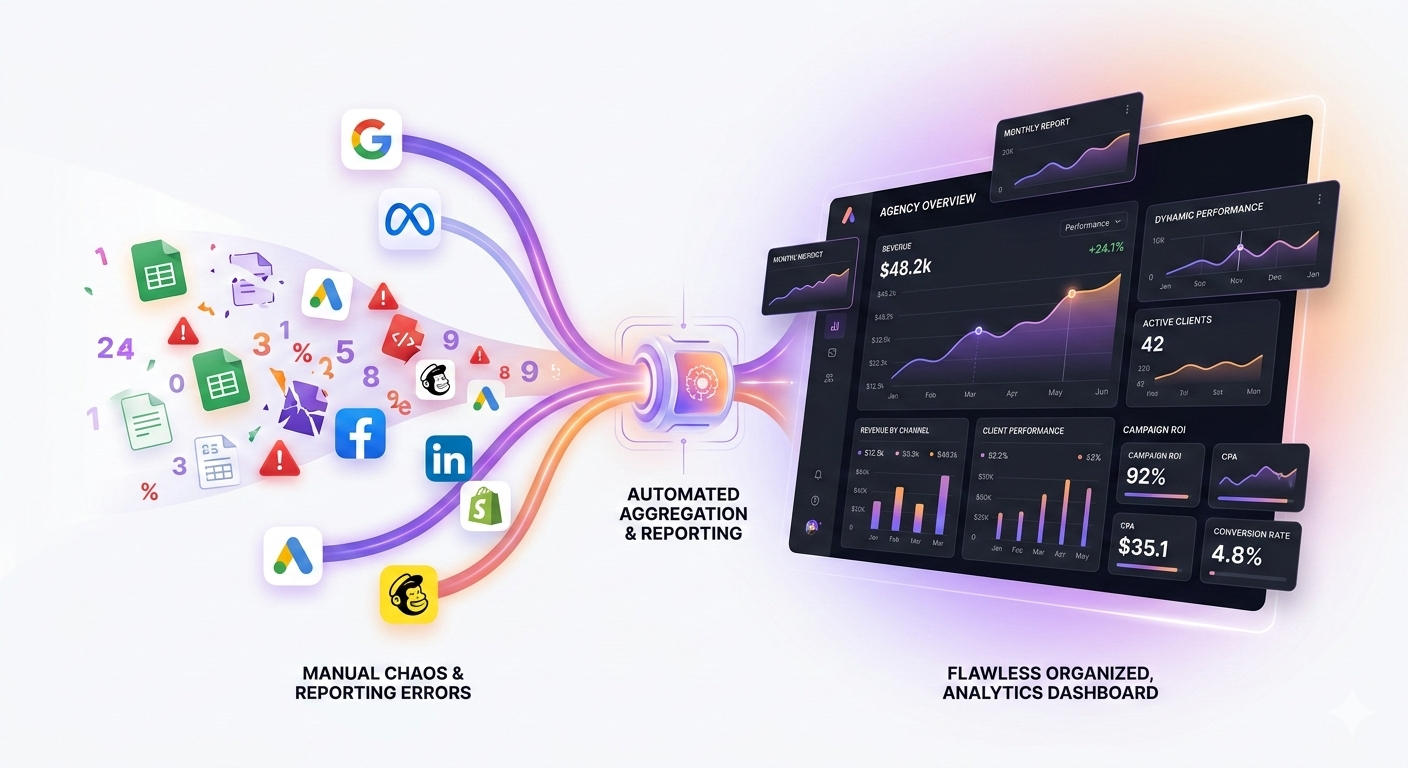
Every agency is familiar with this moment.
You’re preparing a client report. Deadlines are tight. Data comes from five different platforms. Google Ads. Meta. Analytics. CRM. Maybe even a custom dashboard.
You copy the numbers into a spreadsheet, double-check the formulas, adjust the visuals… and send it.
But one small error can undermine the entire report.
A misplaced decimal.
An outdated export.
A formula referencing the wrong cell.
Suddenly, a report meant to build trust does the opposite.
For many agencies, the real question is no longer how to build better reports, but:
How do we eliminate human error in KPI reporting altogether?
Why KPI Reporting Is Still So Error-Prone
Most marketing teams still rely on spreadsheets to compile client reports.
On the surface, spreadsheets feel flexible and familiar. But under the hood they create several structural risks.
First, data must be manually extracted from different platforms. Every export introduces the possibility of outdated or incomplete data.
Second, numbers are manually combined across multiple tabs, formulas and calculations.
Third, visualisation often happens separately, meaning numbers are copied again into charts or slides.
Each step introduces potential error.
Research consistently shows that spreadsheet models contain errors in a significant share of cases. Even small mistakes can distort performance analysis and lead to incorrect conclusions.
For agencies, the impact goes beyond incorrect numbers.
Errors affect credibility, client trust and decision-making.

The Hidden Cost of Spreadsheet Reporting
The Hidden Cost of Spreadsheet Reporting
Manual reporting rarely appears in a profit-and-loss statement, but its cost is very real.
Every month, teams spend hours collecting, verifying and formatting performance data.
Instead of analysing results or improving strategy, valuable time is lost on operational work.
For marketing agencies, this translates directly into lost billable hours.
But time is only part of the equation.
Manual reporting also leads to:
- inconsistent report structures across clients
- increased risk of data interpretation mistakes
- limited scalability when the client base grows
In other words: the more successful an agency becomes, the harder manual reporting becomes to maintain.Automated reporting ensures revenue attribution flows directly from CRM and ad platforms into one single source of truth.
Manual vs Automated KPI Reporting
| Reporting factor | Manual spreadsheet reporting | Automated KPI reporting |
|---|---|---|
| Data collection | Data manually exported from multiple platforms | Data automatically synced from platforms |
| Time spent on reporting | Several hours to days each reporting cycle | Minutes to a few hours |
| Risk of human error | High (manual copy-paste, broken formulas, outdated exports) | Very low (direct data connections) |
| Consistency across clients | Often varies between accounts and team members | Standardised reporting structure |
| Scalability | Becomes harder as the agency grows | Easily scales with more clients |
| Insight generation | Limited time left for analysis | More time for insights and strategy |
| Client perception | Reports can feel operational or inconsistent | Professional, visual and reliable |
What Automated KPI Reporting Changes
Automation fundamentally changes how reporting works.
Instead of exporting data manually, automated systems connect directly to platforms such as advertising tools, analytics platforms and CRM systems.
Data flows into a unified reporting structure in real time.
This removes the most error-prone steps from the process.
Numbers are not copied.
Formulas are not rebuilt every month.
Charts update automatically when new data appears.
For agencies, this creates three immediate benefits.
First, accuracy improves dramatically, because data is pulled directly from the source.
Second, reporting time drops significantly, freeing teams to focus on insights rather than administration.
Third, reports become more consistent, strengthening the professional image agencies present to clients.
In several real-world implementations, reporting processes that previously took months of preparation have been reduced to only a few hours.

From Reporting to Data Storytelling
Automated reporting does more than eliminate spreadsheet errors.
It transforms reporting from an operational task into a strategic tool.
When teams no longer spend hours collecting numbers, they can focus on what clients actually care about: understanding performance.
This is where data storytelling becomes powerful.
Instead of presenting raw numbers, agencies can show:
- what changed
- why performance improved or declined
- which actions should follow
The report becomes less about metrics and more about decision-making.
Clients don’t just receive data.
They receive clarity.
Why Automation Becomes a Competitive Advantage
In a competitive agency market, trust and professionalism matter as much as campaign performance.
Consistent, accurate reporting sends a powerful signal.
It shows that the agency operates with discipline, transparency and control.
Automated reporting supports this by ensuring that every client receives the same level of reporting quality.
Clear dashboards.
Consistent visuals.
Reliable data.
Over time, this consistency strengthens brand perception and builds long-term client confidence.
What once was a back-office task becomes part of the agency’s strategic differentiation.nce.

FAQ
Why do spreadsheet errors happen so often in KPI reporting?
Most errors occur because data is manually exported, copied and recalculated across multiple tools. Each manual step increases the chance of mistakes in formulas, outdated data or incorrect references.
Does automated reporting completely eliminate human error?
Automation removes most operational errors such as incorrect formulas or outdated exports. Human interpretation still plays a role, but the data itself becomes far more reliable.
Is automated reporting only useful for large agencies?
Not at all. Smaller agencies often benefit the most, because automation frees up time that would otherwise be spent on repetitive reporting tasks.
Does automation reduce the need for analysts?
On the contrary. Automation removes manual data preparation, allowing analysts to focus on strategy, insights and client communication.e.

Conclusion
Spreadsheet reporting has long been the default for marketing agencies.
But as client expectations increase and data becomes more complex, manual reporting starts to show its limits.
Automation offers a different approach.
It reduces human error.
It saves time.
And it allows agencies to transform reporting from an administrative task into a strategic advantage.
For agencies looking to grow without increasing operational complexity, automated KPI reporting is no longer a luxury.
It is quickly becoming the new standard.

Support your HR team with reporting that reflects the value they deliver.
📣 Ready to see how much time your team could reclaim?
Request a demo and see how automated reporting can transform your client delivery process – from manual complexity to strategic clarity.