 Skip to content

If you run ESG reporting at a private equity firm, you already know the math does not work. The reporting cycle used to be annual, then the EU made it quarterly, and suddenly the same volume of work has to happen four times as often across a portfolio that keeps growing. The right ESG reporting tool for a private equity firm does not ask you to work faster. It connects every portfolio company’s data to one template and generates every report at once, so a job that used to eat months finishes in an afternoon. That is not a projection. It is exactly what happened to one analyst we work with.
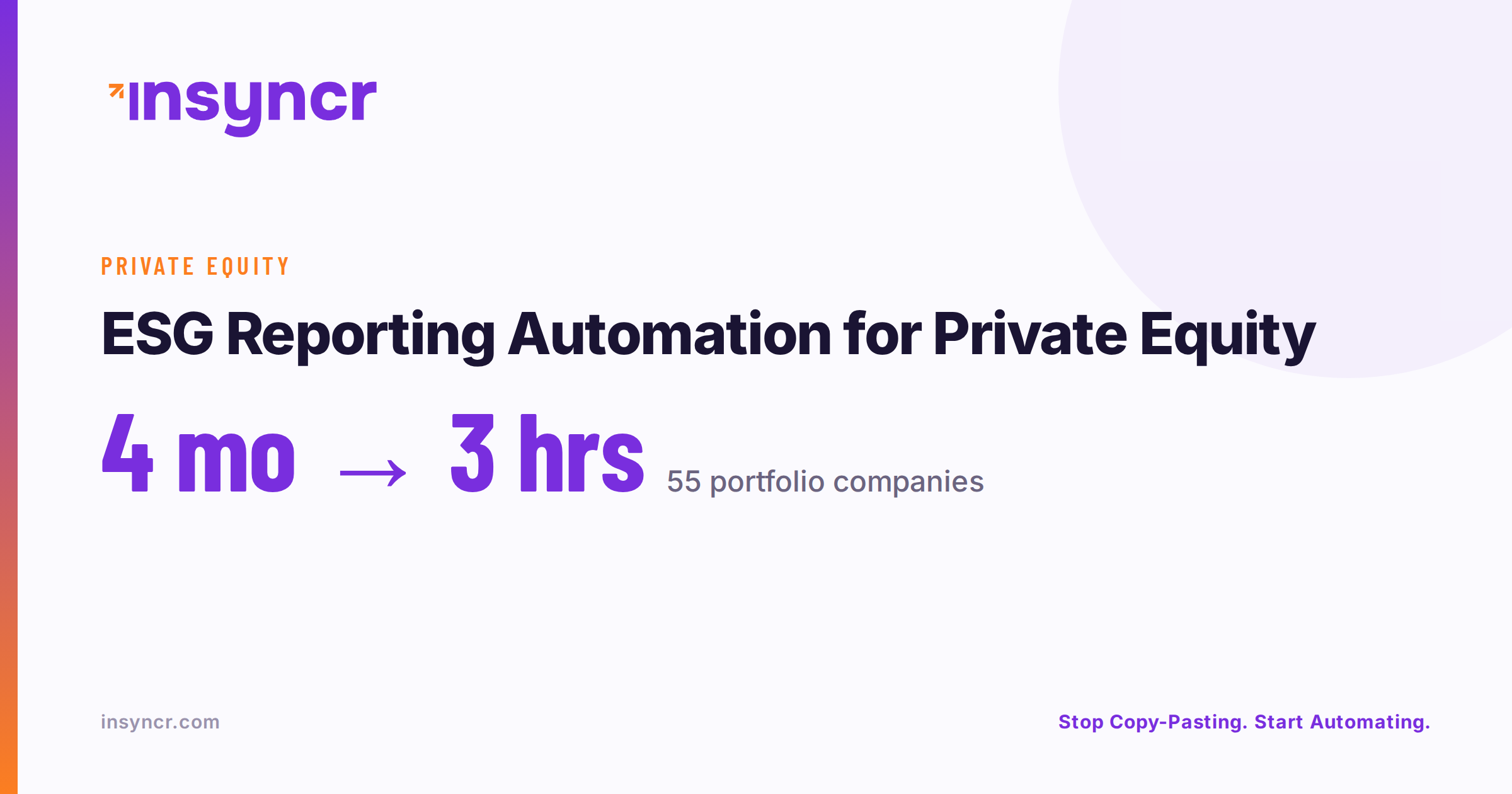
Her name is Francis H., and she is the entire ESG function at a global PE firm with more than 40 billion euros under management. Fifty-five portfolio companies, each with its own data, each needing its own report. Before she automated it, one full reporting cycle took her four months. Then the regulation changed to quarterly, which meant 16 months of work packed into a 12-month year. The only other option on the table was hiring four more analysts at over 280,000 euros a year. Instead she rebuilt the process, and the four months became three hours.
Why ESG reporting breaks a private equity team
ESG reporting is a volume problem disguised as a data problem. Any single portfolio company’s report is manageable. You pull the KPIs, drop them into a template, format the charts, check the numbers, and move on. The trouble is that a PE firm does not have one company. It has dozens, and every one of them stores its data somewhere different, in a different shape, on a different schedule.
So the analyst becomes a human integration layer. Export from one company’s system, reformat, paste into the template, adjust the conditional formatting so red flags actually show red, check every figure against the source, then start the next company. Fifty-five times. By the time the last report is done, the first one is already out of date, and the numbers you validated in week two need re-checking in week fifteen.
That is the trap Francis was in. The work was not intellectually hard. It was just relentless, and it scaled linearly with the portfolio. Add a company, add another few days. Move to quarterly, multiply the whole thing by four. No amount of personal discipline fixes a process that grows faster than the person running it. This is the same structural problem finance teams hit with recurring reports, which we break down in the real cost of your monthly board deck. ESG is that problem at portfolio scale.
What the right ESG reporting tool for private equity does differently
The fix is not a faster analyst or a bigger team. It is a change in where the work happens. Instead of one person moving data into 55 reports by hand, you build one report and let the software produce all 55 from live data.
Here is how Francis set it up. She built a single ESG template in PowerPoint, the format her investment committee already recognized. She applied conditional formatting to the KPIs, so a company missing a target flags automatically instead of being caught by eye. She connected all 55 companies’ data sources to that one template. Then she used Snapshot, the capability that takes one template and one dataset and generates a separate, personalized document for every row. Fifty-five rows of portfolio data became 55 individual ESG reports, generated in one run.
The result was a 97.5 percent reduction in cycle time, four months down to three hours, and roughly 18 times the output capacity from the same one person. In her words, “INSYNCR has reduced my workload from 4 months to 3 hours. I have 55 firms in my portfolio and work for a Private Equity firm.” The quarterly deadline that should have broken her process instead became a non-event, because tripling or quadrupling the frequency of a three-hour job is trivial. Tripling the frequency of a four-month job is impossible.
The reason this works as an ESG reporting tool for private equity specifically, rather than a general charting add-in, is the combination of two things. First, it connects to many sources, not just Excel: SQL databases, Salesforce, SharePoint, Google Sheets, REST APIs and more than 25 others, which matters when 55 companies keep their numbers in 55 different places. Second, Snapshot handles the one-to-many generation that ESG demands. A charting tool helps you draw a nicer waterfall on one slide. It does nothing for the problem of producing 55 complete reports from 55 datasets. Those are different jobs.
The number that made the decision obvious
Francis’s firm ran the same comparison any CFO would. The manual path meant hiring four analysts at more than 280,000 euros a year to absorb the new quarterly load, because one person physically could not do 16 months of work in 12. That is a permanent, six-figure line item added to the fund’s operating cost, forever, just to keep pace with a reporting requirement.
The automation path was a one-time setup measured in hours, run by the analyst who already understood the reports. There was no new headcount, no new department, no consultants building a custom system over six months. She kept working inside PowerPoint, the tool she already used, and connected it to the data she already had. The four analysts were never hired. The three-hour cycle absorbed the quarterly frequency without a blink.
This is the pattern across every reporting-heavy function, not just ESG. When the same report gets rebuilt on a cycle, the cost hides inside salaries and nobody prices it until someone does the arithmetic. We lay out how to find and rank those reports in your own operation in the finance reports to automate first, and the broader case for connecting sources rather than pasting them is in financial reporting integration without the copy-paste.
Beyond ESG, the same engine runs your whole reporting stack
Most teams that automate ESG do not stop there, because the moment one report generates itself, every other recurring report starts to look absurd by comparison. A PE firm’s ESG data lives next to its portfolio monitoring, its LP reporting, and its investor updates, and all of them are the same shape of problem: known template, changing data, painful frequency.
Once the connections exist, extending them is cheap. The same Snapshot approach that turned 55 companies into 55 ESG reports turns a client list into a client report run, which is exactly how agencies use it, covered in automated client reporting for agencies. The engine does not care whether the rows are portfolio companies, clients, or students. It cares that you have a template and a dataset, and it produces one polished document per row.
That is why an ESG reporting tool for private equity ends up being a reporting tool for the whole firm. You buy it to survive the quarterly deadline. You keep it because it quietly removes every other manual report cycle underneath it.
If ESG reporting is currently eating months of your year, the honest way to test this is to run it on one cycle. Start a free trial, build your ESG template once, connect a handful of portfolio companies, and generate their reports with Snapshot to see the time collapse. Or book a demo and we will map your 55, or 155, sources with you and show you the three-hour version of your own process.
Frequently asked questions
What is the best ESG reporting tool for a private equity firm?
The best fit is a tool that connects live data from many sources and generates one report per portfolio company automatically. INSYNCR does this inside PowerPoint using Snapshot, which is how one analyst took a 55-company ESG cycle from four months to three hours without adding headcount.
How do you automate ESG reporting across a portfolio?
You build one ESG template, connect each portfolio company’s data source, apply conditional formatting to the KPIs, then use Snapshot to generate a separate report for every company in a single run. The setup happens once, and each new cycle is a refresh rather than a rebuild.
Can ESG reporting handle the shift from annual to quarterly cycles?
Yes, once it is automated. The problem with quarterly reporting is frequency, and automation makes frequency almost free. Tripling the frequency of a three-hour job is easy, which is why Francis H.’s team absorbed the EU’s quarterly requirement without hiring the four analysts they had budgeted for.
Does an ESG reporting tool for private equity need a new platform?
No. INSYNCR runs as an add-in inside PowerPoint, so analysts work in the tool they already know. It connects to SQL, SharePoint, Salesforce, Google Sheets, REST APIs and more than 25 sources, which is what lets it pull from every portfolio company at once.
What is Snapshot and why does it matter for ESG?
Snapshot takes one template and one dataset and produces a separate, personalized document for every row. For ESG that means 55 portfolio companies become 55 individual reports in one generation. It is the difference between drawing a chart and producing an entire reporting run, and it is what a standard charting add-in cannot do.